Showing posts with label Technology. Show all posts

Friday, January 14, 2011

Review: God's Technology video

My wife was given the opportunity to download a free copy of God's Technology, a video about training our children to rightly use digital technology. It is produced by HeadHeartHand and features David Murray, a professor at Puritan Reformed Theological Seminary. Here is a review.

Dr. Murray presents some guiding principles in how Christians should think about digital technology and some practical steps to guide children to learn how to use them.

Some things I particularly appreciated:
  • He points to God as the ultimate source of digital technology and social media, and that He is to be thanked for them. 
  • Training our children in how to use digital technology doesn't just focus on behavior, but on the heart. He encouraged interaction with our children about their online habits, both good and bad. 
  • Digital monitoring tools are good supplements, but do not replace in person supervision, interacting, and good modeling.
As for the production, it is clean and professional. The visuals support the talk well without being distracting. My one complaint is putting in the animated clip about social networks in the middle of this video. I'm not sure it is necessary, and going between different production styles is jarring.

Overall though, I recommend the video for the practical advice that can be used with any age child on godly use of digital technology.

Thursday, January 06, 2011

New Blog for Technology & Theology

Greetings all - I've started a new blog: A Theology of Technology

You'll find it here:
http://theotechno.blogspot.com/

It's a place to put my various thoughts on how to think about technology as a Christian.  Please come look if you're interested.

Wednesday, December 08, 2010

Technology and Short Term Missions

Interesting article about the relationship of technology to short-term missions. When we didn't have the ability to keep up with friends and family while in a far-flung place, this wasn't an issue as it wasn't really possible. However, now that the Internet is so pervasive, I would think it is a strong temptation for short and long term missionaries to remain closely connected to their home, with a consequence being that they are not fully engaged with the culture they are ministering to.

There's plenty that is good about technology in this sense. Those that support missionaries can get very timely updates about how they are and what needs they have. However, how to use the technology so that it serves this purpose but not to draw the missionary away from engaging with friends in their own culture is difficult.

Kristy and I have lived in three different towns since we were married. I'm very glad to keep up with some of our friends from the previous two towns via Facebook as I want to know what's going on with them. But, I can certainly see how people can get so involved with friends on Facebook that they don't make time for friends that are real and present here.

While I miss many people that are in other locations, I'm called to be with those that are here, geographically. In spite of Internet hype, geography is still an essential factor of life, and I think the more deep ministries (e.g., of the church) recognize that.

Sunday, November 28, 2010

Forcing Tech on Others

A fellow named John Dyer has an interesting post on his blog about how since his father cannot access the Internet, he does not get all of John's updates about his life. He must use "older" technology like the phone or postal mail to keep up or send pictures.

This inspired a few thoughts.  One is that we have higher expectations of others to keep up with our lives.  We expect them to use the same tech we do, such as Twitter, Facebook, or just a blog, and to follow those in whatever way they wish to keep up with what we're doing.  That can be framed in a positive light as allowing others to choose whether or not to keep up with us.  It can also be framed as us expecting them to conform to our means of communication and to make sure they check it on some regular basis to find out if there's an update.  It seems to me that if we really value someone, we will want to keep up with them no matter the technology medium.

A second thought is that our communications to let others know what we're up to has become less personal as it has become easier to broadcast.  I remember when my mother would hand write individual letters to friends at Christmastime.  Family friends started writing a generic letter that was just copied and sent to everyone, and mom decided at some point to do that as well.  Kristy and I only do a generic letter at Christmas, as do most (maybe all?) of our friends.  Surely that's multiplied now as our Facebook status gets broadcast to anyone with permission to read it.  Now, it would take quite a bit of time to write individual letters, or even individual electronic messages to everyone I would like to send an update to.  The technology (copiers, printers, Facebook, Twitter) now facilitate broadcasting an impersonal message.  It's much easier, but I fear we've lost meaningful personal contact in the process of getting to this point.

What do you think?  What is lost and what is gained in terms of keeping up with people?

Friday, March 26, 2010

Glued to technology

Our family went out to a local restaurant last week, and I keep reflecting on an incident there. We were in a row of booth/tables and soon after we sat down, a young couple (probably undergrads) were seated next to us. At least I assume they were a couple as they came in together. They said less than 10 words to each other the whole time we were there.

Why? The guy spent almost the entire time texting on his phone. He started soon after he sat down, paused to order, and started up again. At first, I thought it odd but assumed he was finishing up some text conversation. Our family continued our conversation and fun. The place had a bunch of "stuff" hanging from the ceiling so that was a distraction for the kids for a while. Later, during a lull in the kids activities, I noticed that the guy was texting (still?). I hadn't heard a word from their direction in a while - so even if there was a time when he was not texting, he wasn't exactly making conversation.

Now, I have no idea what the girl is like, but she seemed to be putting up with this with great patience. If this is habitual behavior, I think she should dump him for treating her rudely. Should we be so attached to being connected anytime, anywhere, that we ignore the person in front of us?

And I would be remiss not to give a plug for Nick & Nate's where this happened.

Friday, January 01, 2010

Another Homemade Movie

Being off work is great. Stephen and I made another movie. Compared to the last one, it has a similar plot, different protagonist and new Special Effects.

Enjoy!


In case you didn't quite catch the title, it is "Dinosaur Rescue the Princess from the Globbies Good Luck." Once again Stephen's choice.

I have no idea where "globbies" comes from.

Sunday, October 11, 2009

Homemade Movie

Kristy was gone to a sale in Greenville (got some good stuff) so I was home yesterday (Saturday) with the kids. Stephen's creativity always amazes me, so I decided to work on a creative outlet to encourage that.

We made a movie.

Here it is in all it's glory. We got through our creative differences, various production issues, and managed our low budget. We did all the set design and video shooting while Lydia had her nap and I finished editing it later that evening.

The title was Stephen's idea.


It's silly, but it sure was lots of fun.

Tuesday, June 02, 2009

Thursday, May 28, 2009

The Screaming Bullet

Stephen and I have been working on a little project. Here's the setup: the wobbly leg on our TV stand finally gave out, so the TV is now on the footlocker for a while and the old stand/table was in our bedroom until we could decide what to do with it. Around this time, Stephen was watching some TaleSpin episodes (which he likes as much as the Rescue Rangers). He would then go in to our room, sit at the old table, and pretend he was flying an airplane. Well, I wondered if there was a toy cockpit out there somewhere and then realized it would be much more fun to make our own.

So, at the craft store, we purchased:
  • A bag of thin wooden pieces in various shapes (squares, circles, etc.)
  • Some paint
  • Wooden toy wheels
  • The wooden face for a clock
  • Lots of stickers
Then, at Lowe's we bought:
  • A plastic playground steering wheel (the most expensive item of all this at around $8)
  • A long wood dowel
Over a few evenings we painted our control buttons, removed or nailed down the table legs, glued on the buttons, drilled a hole for the dowel, and glued on the clock face. Stephen and I both enjoyed the project and had some good father-son time.

I wanted this to be a general-purpose cockpit, so I avoided making permanent wings. That way, it could be a race car, boat, space ship, etc. at some point. But, Stephen was very interested in just having an airplane. So, we (meaning I) cut up a diaper box into wings and a propeller. A little duck tape, and they're attached.

Stephen and I then worked on a name for it. After going through various names, he combined a few things I suggested into the "Screaming Bullet" which I thought was a great idea. We made the logo together and Stephen glued it on the wings.

Here's Stephen playing with it:


Here you can see the shaft we made with the dowel that lets him turn the wheel and...


..."spin" the propeller, which is the clock face glued to the end of the dowel and the cardboard propeller attached to it.


Even if you can buy a kid-size cockpit, this was much more fun to make ourselves.

My one regret is not figuring out how to make a throttle of some sort. I couldn't think how to make a lever with some resistance so it would stay in position. Any thoughts on this would be welcome - preferably something for less than $8.

Sunday, March 29, 2009

Sunday School Lesson on Technology

These are my notes from a single-Sunday lesson I did this morning on the Christian view of technology. It's a one-off, but I could see expanding this some day into several weeks. Note that I'm drawing largely from the book Responsible Technology, which I've blogged about before.

1. Introduction
Why care?
  • Technology is pervasive in our lives – How many of you are wearing technology?
  • Consider the automobile – What things have entered society since the introduction of the automobile? (Manufacturing, laws, gasoline, repairs, highways, etc.)
  • This omnipresence is almost to the point of being unquestioned
  • Technology is part of subduing the earth (Genesis 1:28, 2:15)
  • We are to take every thought captive (II Corinthians 10:4-5)
  • We are to do all our work for God’s glory (Col 3:17)
  • Technology extend our actions and abilities, but they are still OUR actions and abilities, for which we are accountable (Ex. 20 – we are responsible if we steal, whether we do it at gunpoint or through a computer); that is, we can instill our values in technology
  • Technology is done in a cultural context, within a worldview, and that worldview will pervade the technology
2. Defining Technology
What is technology? How is the term used in our culture? How do you define it?

Definition from Responsible Technology book
A distinct human cultural activity in which human beings exercise freedom and responsibility in response to God by forming and transforming the natural creation, with the aid of tools and procedures, for practical ends and purposes.
This definition works before and after the Fall.

3. Good and Evil in Technology
Do you think technology can be good and/or evil in and of itself?

What technology would you consider good?
• Telephone/911
• Vaccines
• Water wells
• Fence around your roof (Deuteronomy 22:8)

What technology do you consider evil?
• Torture devices
• Auschwitz
• Biological weapons
• Tower of Babel (Genesis 11:3-4)

What has a mixture of good and evil?
• Internet

What sinful motivations can we have in designing and using technology?
• Personal comfort at exclusion of other things
• Greed
• Pride (tower of Babel)

4. Technology In the Church (if time)
What technology is prescribed for the church?
• Baking bread
• Making wine

Other technology may be beneficial as well (audio system, musical instruments, lighting), but some not so (virtual worship services).

5. How shall we then live?
Some of us design and work on technology, all of us use it.
For designers:
• What values guide you in technology?
• Do you work evil or good?
• How can you pursue righteousness, justice, and peace in your technology?

For all of us: How do you decide whether or not you will use a particular technology?

Saturday, September 20, 2008

The Big Dig

This morning, my dad, Stephen, and I went to this.

Stephen did this (he dug a little bit):


Then this (he got to sit there for a bit):


And this (look for the yellow helmet just around the driver's chest):


Stephen also rode on a backhoe, but I don't have pictures since I was busy on the excavator next to him. I think he dug more dirt than I did, but he was much more experienced by then. We both had a really great time. Now THAT was a great fundraiser.

Friday, March 21, 2008

Upgrading to XP from Vista

The hard drive on the family laptop died in December, so we bought a new desktop. We got an HP Pavilion Slimline – small but still a desktop. I thought it would be nice to go back to having a desktop to get the better display and regular size keyboard. And, NC state employees get a nice discount with HP.

Well, we got it and like it. We had a small problem with the monitor (a bright yellow, one pixel wide vertical line on all the time) which they replaced quickly. The hardware is a nice jump from our 4 year old laptop, and we didn’t know how much we missed having a number pad on the keyboard.

However, it also came with Vista. It is pretty and has decent navigation. It didn’t take long to get used to it. But, the problems soon started. About every 1-2 weeks we got the blue screen of death (BSOD) and had to restart several times before Vista would start again. Explorer also froze whenever we copied, moved, or even renamed files. Updates didn’t help, and sometimes had a BSOD while installing them!

So, we finally got sick of it. One of the advantages of working at WCU is that faculty and staff get a discount on lots of software. I got a copy of XP for $10 and installed it. I have to give it to HP: even though their policy is to only support the pre-installed operating system, they pointed me to all the drivers I needed (except for the modem – which I found myself). It only took about 1.5 hours to go from Vista to fully running with XP AND all our necessary software.

Updating XP through dial-up took longer, but at least it doesn’t crash regularly. Now if we can just get DSL...

Sunday, October 22, 2006

Responsible Technology - Chapter 1(b)

(Maybe I can actually post more often someday) The next part of this first chapter of Responsible Technology lists four reasons why we must understand technology with our heart as well as our mind.

1) The pervasiveness and power of technology. Do we see how technology can shape cultural values? Consider the effects of the television on politics (sick of the ads yet?), child-rearing, and evangelism. Consider the implications of the technology known as the automobile. Such technology requires roads and bridges to be built and maintained, gas stations, maintenance and repair facilities (and expertise), structures at our dwelling (driveway, carport, garage, etc.), and law and government structures (taxes, enforcement, licensing) just to name a few. That doesn't even include manufacturing them.

2) The value-ladenness of technology. This concerns not just the use of technology, but the technology itself involves valuing. This is focused just as much (if not more so) on the designers and engineers as users. An engineer makes decisions and trade-offs when designing technology, e.g., valuing cheaper materials over durability.

3) Conflicting opinions regarding technology. Some praise technology for bringing increased "progress." And yes, we do have better and faster communication and automation. We can do amazing things that could not possibly have been done without the technology (e.g., going to the moon). Some condemn technology for depersonalization (we can assign you a number for our records, and so we do) and destruction (not just nuclear weapons, but environmental damage)

4) The divergent nature of today's technology. The authors write some years ago, yet I think their claim still holds. The nature of modern technology has the potential to be oppressive & evil and can simultaneously be a very positive force. Example (from the book): a new strain of rice is developed that greatly increases production but requires harmful chemical fertilizers and pesticides. How do we determine if this is good or bad?

I think that's enough food for thought at the moment. Consider those four reasons for being sure we understand, design, and use technology not just in an intellectual, logical way, but also morally with our hearts.

Thursday, September 21, 2006

Responsible Technology - Chapter 1(a)

As you may have noticed, many things in my life take precedence over blogging.

In Chapter 1 of Responsible Technology, the authors point out that technology is so omnipresent in our society that it often goes unnoticed & unquestioned. I work on a university campus, and it amazes me how many students walk around using cellphones and music players.

Bold Claim: To paraphrase the authors, the beliefs that infuse technology, processes that mark it, and outputs from it are not inevitable, neutral, or necessarily benign. Consider Colossians 3:17 - whether we design or use technology, we are called to do it for God and His glory.

Here's a personal anecdote to illustrate. When my wife and I got married, we started our marriage together in a nice little apartment. Within about 2 weeks of moving in, a salesman from the local cable company came by and asked if we would like to sign up for one of their packages. He was surprised when I declined and asked "why not?" I told him that we were newly married and felt the need to spend time interacting and building our relationship. We planned to read books out loud to each other for entertainment and didn't want TV to get in the way of that. While he looked at me like I was from Jupiter, he didn't press the issue further. In this instance, my wife and I chose older technology (books) over newer - and I believe our marriage has been better for it. We did not inevitably need cable, nor did I think it would have a neutral impact on our new marriage.

There is much more to Chapter 1, so stay tuned!

(Post script: a few years ago, I broke down and bought an antenna.)

Monday, September 04, 2006

Lord of Technology

I've been thinking about technology over the past several months (more like year) in terms of how the Christian faith impacts and interacts with it. Two articles in the PCA's magazine caught my eye: Technology and Worship and Technology and the Church. I especially recommend the second, and perhaps I will write some thoughts on it in the future.

At present though, I've throught about this as a Christian engineer. Is engineering independent of my faith? I mean, concrete crushes under a certain amount of pressure, whether you're a Christian or athiest. Looking at my work, is Work Action Analysis a morally neutral systems modeling tool?

My rudimentary thoughts on this have been profoundly impacted by one book I read a while back:


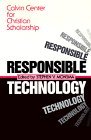
Responsible Technology, edited by Stephen Monsma (Yes, I'm an Amazon Associate)


I'll (hopefully) be writing about the first few chapters of this book and how it has shaped my thinking. Honestly, this book has changed my thinking more than any other I have read in several years. It is written by six authors and edited by one of them. They examine the issue from a Reformed perspective, and are very influenced by the thinking of Abraham Kuyper (of whom I am relatively ignorant).

First, a few notes from the preface. The authors claim that while technology is a crucial part of our lives, Christians pay little attention to it. For my part, I think we Christians look at it either as a neutral tool or in terms of the bad things it can bring into our lives (bad movies, the Internet, etc.). The authors' also claim that "doing technology" is not a neutral activity - rather it involves assigning values to different aspects of technology and is therefore moral. My conclusion is that engineering is therefore an essentially moral activity. Having finished the book, I agree with their claim. The authors also claim
"that technology, as one form of human cultural activity, must be done under the Lordship of Jesus Christ" (p. ix)

That is a bold claim, and I believe they back it up in the rest of the book. Come back in a few days and hopefully I will post more.